Adaptive Standard Delivery Time Calculation
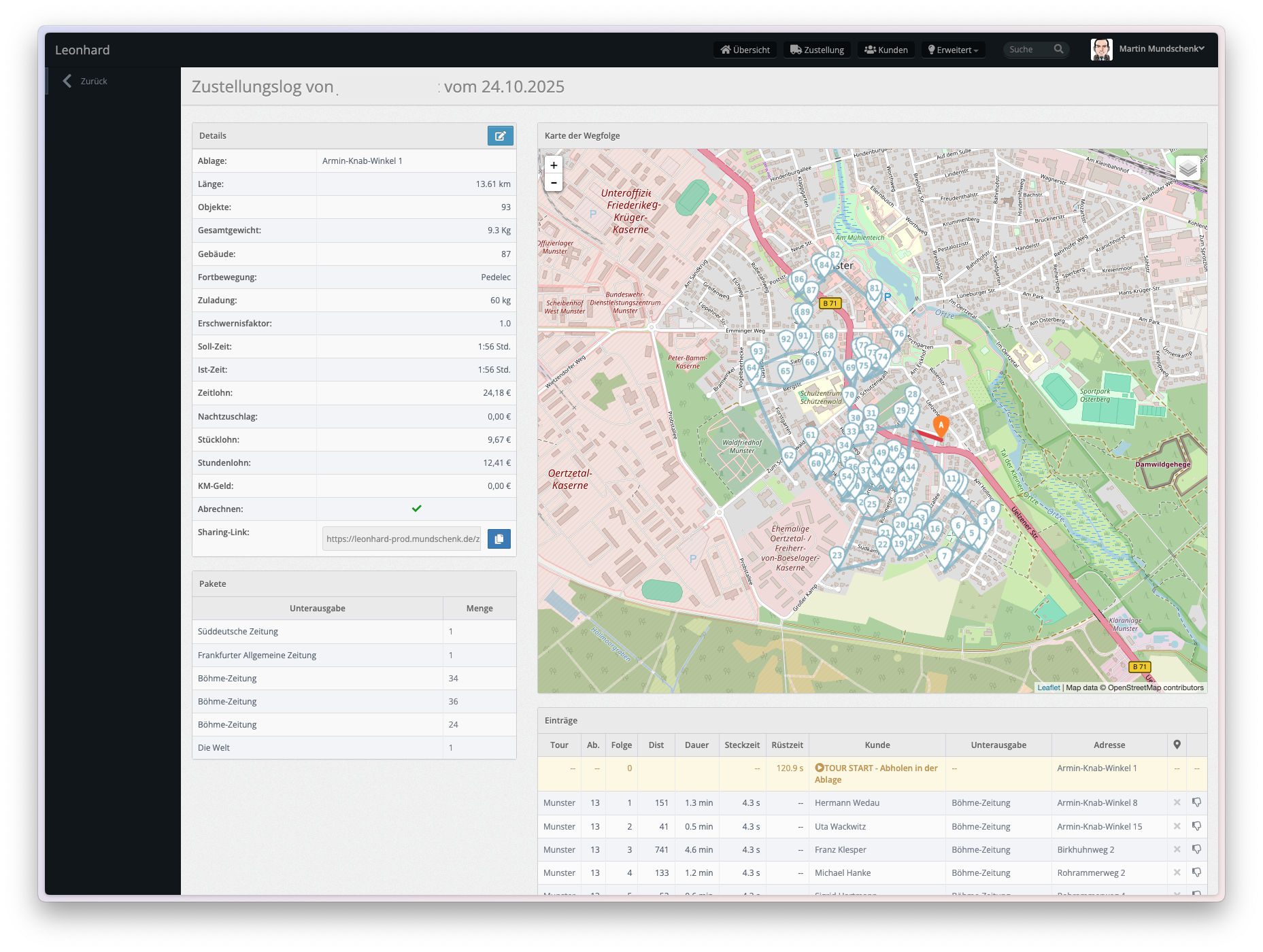
Fair and transparent standard delivery time calculation on a scientific basis. LEONHARD combines precise geospatial data, proven algorithms and empirical measurements for a legally sound, daily-adjusted time recording.
The foundation: precise digital map data
A fair and accurate standard delivery time calculation begins with precise geospatial data. LEONHARD uses high-quality map data based on OpenStreetMap and OpenRouteService from Heidelberg University, supplemented by precise house data from the land registry offices.
This combination guarantees exact house positions for every delivery point, detailed street information including traffic routes, and access path data from the roadside to the letterbox. The digital map is kept current through regular updates and forms the foundation for all further calculations.
Optimal route calculation with operations research
LEONHARD calculates the optimal route for every delivery region using the traveling salesman problem (TSP). This takes into account not only street distances but also access paths to letterboxes, return paths to the drop-off point for reloading, and traffic routes within apartment buildings.
For the initial calculation of new delivery regions, the highly efficient Lin–Kernighan heuristic (Linkern) is used – one of the most powerful TSP solvers in the world. For the daily adjustment of existing routes, LEONHARD uses the 3-Opt algorithm, implemented in Go, with parallel processing.
The result: the shortest possible route for all delivery points, which serves as the basis for fair standard delivery time calculation.
The three pillars: preparation time, travel time, letterbox delivery time
Total standard delivery time is made up of three scientifically determined components. Preparation time covers sorting newspapers and inserts, loading the means of transport, and organizational preparation at the drop-off point.
Travel time is calculated based on measured distances and speeds. GPS-based measurements with experienced carriers have shown that speed varies depending on the distance between houses. LEONHARD accounts for these varying speeds and stop-and-go factors for closely spaced houses.
Letterbox delivery time – the time for putting the newspaper in – was measured under real conditions and varies depending on the distribution channel: letterbox, newspaper tube, or apartment building with different accessibility.
Vehicle-type-specific calculation and reloading management
LEONHARD accounts for the specifics of different modes of transport: on foot, bicycle, e-bike, Paxter/small electric vehicle, or moped/car. Each mode of transport has its own speed curves and payload capacities that feed into the calculation.
With limited payload capacity – for example 20 kg on a bicycle – LEONHARD automatically calculates optimal partial routes within the weight limits. The necessary return paths to the drop-off point for reloading are taken into account, as are the access routes to the next route section and the additional time for loading and unloading.
The bicycle has proven to be particularly efficient in practice. New small electric vehicles such as the Paxter can even further increase efficiency through higher payload and optimal speed.
Daily adjustments and weight variations
Standard delivery time is not static but varies daily. Weekend editions are usually thicker and heavier, free advertising newspapers have strongly fluctuating insert volumes, and special editions can contain additional magazines or supplements.
LEONHARD recalculates standard delivery times every day, based on the current circulation per delivery point, the weight of inserts, the resulting number of necessary reloadings, and changed delivery addresses. This automatic recalculation guarantees that the standard delivery time always matches the actual requirements.
Scientific grounding: GPS tracking and empirical measurements
LEONHARD’s standard delivery time calculation is based on extensive GPS tracking of real delivery rounds and time measurements with experienced carriers. This data was statistically evaluated across various regions and conditions, and the calculation models were continuously validated.
The mathematical optimization uses proven TSP algorithms for shortest paths, operations research methods, parallel processing for fast calculations, and adaptive models for various environments – from dense urban areas to extensive rural regions.
This scientific approach ensures that standard delivery times are neither unrealistically tight nor overly generous, but correspond to the average values of experienced carriers.
Standard time vs. actual time: a fair and performance-oriented system
The time actually needed (actual time) naturally deviates from the calculated standard delivery time – sometimes faster, sometimes slower. However, what is paid is always the calculated standard delivery time. This rule is deliberately chosen and has good reasons.
Paying based on actual time would create a wrong incentive: those who work more slowly would earn more. Those who complete their work efficiently and quickly would get less. That would not only be unfair to committed employees but would also contradict the basic principle of performance-based fairness.
Example: with a calculated standard delivery time of 2.75 hours, both carrier A (needs 3.0 hours) and carrier B (needs 2.5 hours) are paid the fair standard delivery time of 2.75 hours. The system rewards efficiency without imposing unrealistic requirements. This approach is also legally permissible, since carriers carry out their work independently and on their own responsibility.
Route optimization: route-optimized instead of area-optimized
Unlike classic geographic area divisions, LEONHARD works with optimized routes. This means: routes can cross, several carriers can be out and about in the same neighborhood at the same time. The shortest overall distance takes priority, not adherence to geographic boundaries.
Even if it may initially seem illogical for routes to overlap – this system demonstrably leads to shorter total times and fairer working conditions for everyone. The efficiency gain also enables better adaptation to circulation changes without having to redraw the entire delivery district structure.
Continuous improvement and API transparency
LEONHARD, as an API-first platform, enables weekly evaluations of actual times and adjustments in the event of systematic deviations. Feedback from carriers is incorporated, and seasonal optimizations (e.g. for winter or summer) can be carried out.
Via the LEONHARD API you can view the calculation basis for every route at any time, trace the individual standard delivery time components (preparation, travel, letterbox delivery time), analyze the historical development, and retrieve comparative figures. This transparency builds trust and enables continuous improvement of the system.
Benefits for publishers and carriers
For publishers, LEONHARD’s standard delivery time calculation means: legally sound billing on a scientific basis, fair treatment of all carriers, automatic adjustment to daily fluctuations, transparent documentation for audits, cost optimization through efficient routes, and automatically guaranteed minimum wage (Mindestlohn) compliance.
For carriers, the system offers: fair standard delivery times based on real measurements, predictable pay independent of day-to-day form, transparent calculation documented in a comprehensible way, performance orientation (efficiency is rewarded), and daily up-to-date adjustment to circulation changes.
LEONHARD’s standard delivery time calculation combines scientific precision with practical applicability. Daily recalculation guarantees that changes in circulation, weight and delivery structure are taken into account immediately. The result is a modern, API-supported solution for one of the most complex problems in newspaper distribution logistics.
Carriers see the calculated standard delivery time directly on the round card in the Paperboy app for carriers – including the number of addresses and progress on the final mile.
Discover more features
LEONHARD gives you a comprehensive solution for your newspaper distribution logistics
Delivery route optimization
Proven algorithms from operations research
Newspaper title and edition hierarchy
Map complex media landscapes
Delivery district optimization
Multi-criteria optimization of delivery districts
API and integrations
OpenAPI and bidirectional webhooks
AI integration and MCP server
95% automation through AI-native integration
Sandbox and scenarios
Digital twin for what-if analysis
Newspaper carrier payroll
Legally compliant payroll in just a few clicks
Subscription management
Flexible subscription management and IVW-compliant recording
Delivery quality management
Complaint management and systematic quality assurance
Interested?
Learn more about how LEONHARD can revolutionize your logistics. Talk to us about your challenges.
Get in touch now