Subscription Management & Distribution Control
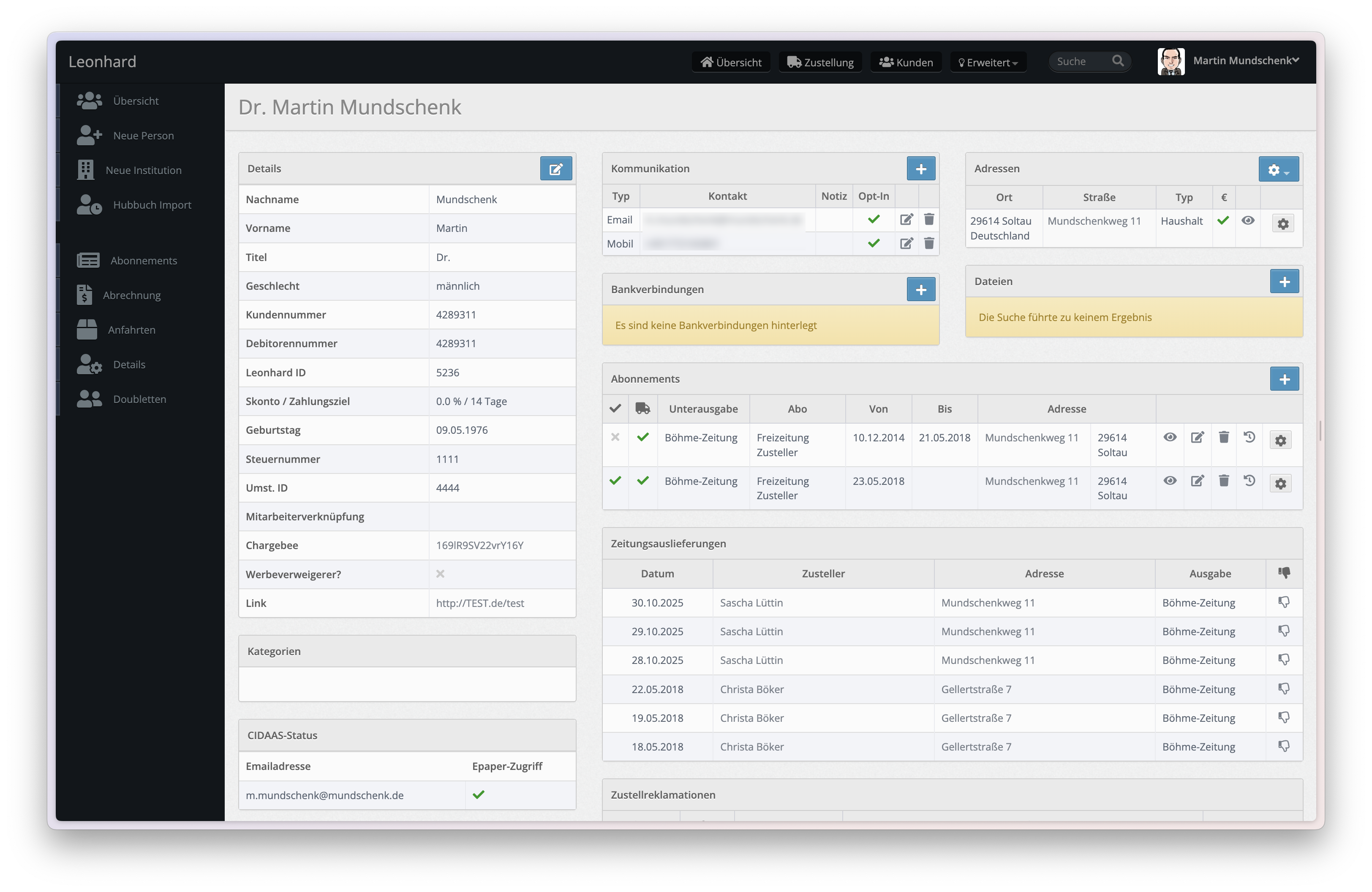
Manage your entire subscriber base in one system – from new orders through suspensions to cancellation. LEONHARD maps all distribution channels, publication schedules and newspaper title and edition hierarchies and guarantees IVW-compliant data recording.
Flexible newspaper title and edition hierarchies: from simple to highly complex
Newspaper publishers often have complex product structures: multiple titles, various regional editions, different publication schedules and diverse subscription types. LEONHARD maps this diversity with a 5-level hierarchy model that guarantees maximum flexibility while keeping everything manageable.
The hierarchy begins with the main title (e.g. ‘Tagesanzeiger’), followed by regional editions (e.g. ‘Tagesanzeiger Nord’, ‘Tagesanzeiger Süd’). Each regional edition can have different publication schedules (daily Mon–Sat, weekends only, weekly on Wednesday). From this, concrete subscription products emerge with prices and terms. The actual customer contract finally links a customer with a subscription at a specific delivery address.
This structure allows publishers to map practically any conceivable combination: daily newspapers with a weekend supplement, free advertising newspapers with different distribution areas, seasonal editions (e.g. a tourism newspaper only in summer) or inserts with their own rhythm. New products can be created without system programming – simply by configuring the existing structure.
All distribution channels in one system
Modern newspaper publishers use several distribution channels in parallel. LEONHARD supports all common distribution channels and allows flexible combination within a single subscription. Customers can receive the same title at home via a carrier and have it redirected by post while on holiday.
Carrier delivery: classic home delivery via newspaper carriers is fully integrated into delivery route planning and payroll calculation. Every subscription is automatically assigned to the optimal delivery round, standard delivery times are recalculated daily, and carrier payroll is generated at the push of a button. When addresses change or new subscriptions are added, the delivery round structure is adjusted automatically.
Collection boxes and vending machines: collection machines are a good fit for urban locations with high foot traffic. LEONHARD manages the locations, calculates the required fill quantities, and plans delivery to the machines as part of truck distribution logistics. Customers with collection-box subscriptions are not included in carrier delivery, which optimizes delivery route planning.
Postal delivery: for remote areas or temporary redirections (e.g. during a holiday), delivery can be carried out via Deutsche Post (postal delivery, Postzustellung). The system automatically generates the necessary address lists for the postal service and factors postage costs into the calculation. Temporarily switching from carrier delivery to postal delivery (and back) is possible with a few clicks.
Retail and kiosk: points of sale such as kiosks, gas stations or railway station bookshops are managed as special subscribers. LEONHARD plans delivery to these points of sale, manages unsold returns and enables precise inventory management. Delivery quantities can be adjusted dynamically – based on historical sales figures.
Outsourced distribution: for special areas or out-of-area deliveries, external logistics providers can be integrated. The system generates the necessary delivery lists, transmits them to the outsourced distribution provider and manages cost settlement. The interface works via CSV export or API integration, depending on the provider’s requirements.
Subscription types: from full subscription to trial subscription
LEONHARD supports all common subscription types in the newspaper publishing industry. The flexible product configuration makes it possible to define the right subscription model for every target group and every marketing scenario.
Full subscriptions form the standard type: the customer receives the newspaper on all publication days of a defined publication schedule. Example: ‘daily newspaper Monday to Saturday’ or ‘weekly newspaper every Wednesday’. Billing follows the agreed term (monthly, quarterly, annually), and delivery runs automatically until cancellation.
Selected-day subscriptions deliver only on chosen weekdays. A popular example is the ‘weekend subscription’, where customers receive only the Saturday and Sunday edition. LEONHARD enables any combination: Monday/Wednesday/Friday only, Thursday only (for free advertising newspapers with flyer inserts), or any other conceivable constellation. Delivery route planning automatically accounts for the fact that these customers are not delivered to daily.
Trial subscriptions are time-limited and serve new customer acquisition. The system manages the expiry date automatically and can be configured to generate a reminder before expiry (e.g. ‘Your trial subscription ends in 7 days – switch to a full subscription now’). After expiry, delivery is automatically stopped, or – with appropriate configuration – converted into a full subscription.
Free subscriptions are often used for strategic distribution: employee subscriptions, multipliers (mayors, club chairpersons), promotional purposes in new housing developments or business partners. These subscriptions have a price of €0 but are treated logistically identically to paid subscriptions – including delivery route planning, standard delivery time calculation and complaint recording.
Fixed-term subscriptions end automatically after a defined term (e.g. 3 months, 12 issues). The system stops delivery at the agreed point in time without manual cancellation. This is especially relevant for gift subscriptions or seasonal offers. The fixed term can be defined in days, weeks, months or number of issues.
Suspensions and redirections: flexibility for your customers
Holiday suspensions and redirections are everyday occurrences in the newspaper business. LEONHARD fully automates these processes and significantly reduces administrative effort.
Holiday suspensions are recorded with a start and end date. The system automatically stops delivery on the first day of the holiday and resumes it the day after the holiday ends. Delivery route planning is adjusted accordingly: carriers with many holiday suspensions get shorter rounds, and standard delivery times are recalculated. Upon return from holiday, reintegration into the round happens seamlessly.
Redirections during a holiday can be configured in parallel with the suspension: the newspaper is not delivered to the home address but redirected to the holiday address. The system automatically distinguishes whether the redirection is handled by carrier (for holiday destinations within the delivery area), by post, or via outsourced distribution. Postage or additional costs are recorded separately.
Permanent address changes (e.g. due to moving) are stored with version history. Every address change automatically triggers a recalculation of the delivery round structure: the customer is removed from the old round, integrated into the new round, and the standard delivery times of both affected rounds are adjusted. The historical delivery address remains documented for billing purposes.
IVW-compliant data recording and reporting
The IVW (German circulation auditing body) is the central body for circulation verification for publishers. Advertising customers rely on IVW figures, and strict rules apply for inclusion in the IVW statistics. LEONHARD is designed so that all data recording is IVW-compliant.
Sold circulation vs. distributed circulation: the system clearly distinguishes between different distribution types. Paid subscriptions, trial subscriptions under 50% discount, free promotional distribution and unsold returns (from retail) are recorded separately. This corresponds to the IVW categories and enables automatic assignment during quarterly reporting.
Gapless delivery documentation: for every publication day, LEONHARD logs which subscriptions were active, which copies were delivered, and which distribution channel was used. This day-accurate history is the basis for IVW reporting and can serve as evidence during audits. Suspensions, redirections and address changes are fully documented.
Automatic aggregation for IVW reports: the system generates, at the push of a button, the key figures required for IVW quarterly reporting: average sold circulation per publication day, broken down by distribution channel (carrier, postal delivery, retail), geographic distribution by postal code area, and the share of trial and promotional subscriptions. The data can be exported as CSV or converted directly into IVW-compliant reporting formats.
Auditability: all subscription-relevant data changes are versioned with a timestamp and user. During an IVW audit, the system can document exactly, for any past reference date, which subscriptions were active, which prices applied and which discounts were granted. This immutability of historical data creates legal certainty.
Scaling for publishing groups: central management, local autonomy
Modern newspaper publishers are often part of larger media groups with multiple titles and regional companies. LEONHARD is designed to enable both central control and local autonomy.
Multi-tenancy: publishing groups can manage all titles in a shared instance, with each publisher (or each regional edition) run as its own tenant. This enables central evaluations (group-wide KPIs, cross-title distribution analyses) while maintaining data separation for operational processes. Local dispatchers see only ’their’ delivery rounds and subscribers.
Shared delivery infrastructure: where there is geographic overlap, several titles can use the same carriers. A carrier then delivers, for example, the ‘daily newspaper’ and the ‘weekly newspaper’ at the same time. LEONHARD automatically plans these multi-product rounds and accounts for the different publication schedules when calculating standard delivery times. Payroll is processed correctly even when a carrier works for several clients.
Central master data maintenance with local adjustments: product templates, price lists and terms and conditions can be defined centrally and distributed to all tenants. Local companies can adopt these templates or maintain their own variants. Changes to central specifications (e.g. a price increase) can be rolled out automatically to all tenants or released manually.
Discover more features
LEONHARD gives you a comprehensive solution for your newspaper distribution logistics
Delivery route optimization
Proven algorithms from operations research
Newspaper title and edition hierarchy
Map complex media landscapes
Standard delivery time calculation
Daily adaptive recalculation
Delivery district optimization
Multi-criteria optimization of delivery districts
API and integrations
OpenAPI and bidirectional webhooks
AI integration and MCP server
95% automation through AI-native integration
Sandbox and scenarios
Digital twin for what-if analysis
Newspaper carrier payroll
Legally compliant payroll in just a few clicks
Delivery quality management
Complaint management and systematic quality assurance
Interested?
Learn more about how LEONHARD can revolutionize your logistics. Talk to us about your challenges.
Get in touch now