Delivery Quality Management & Complaint Handling
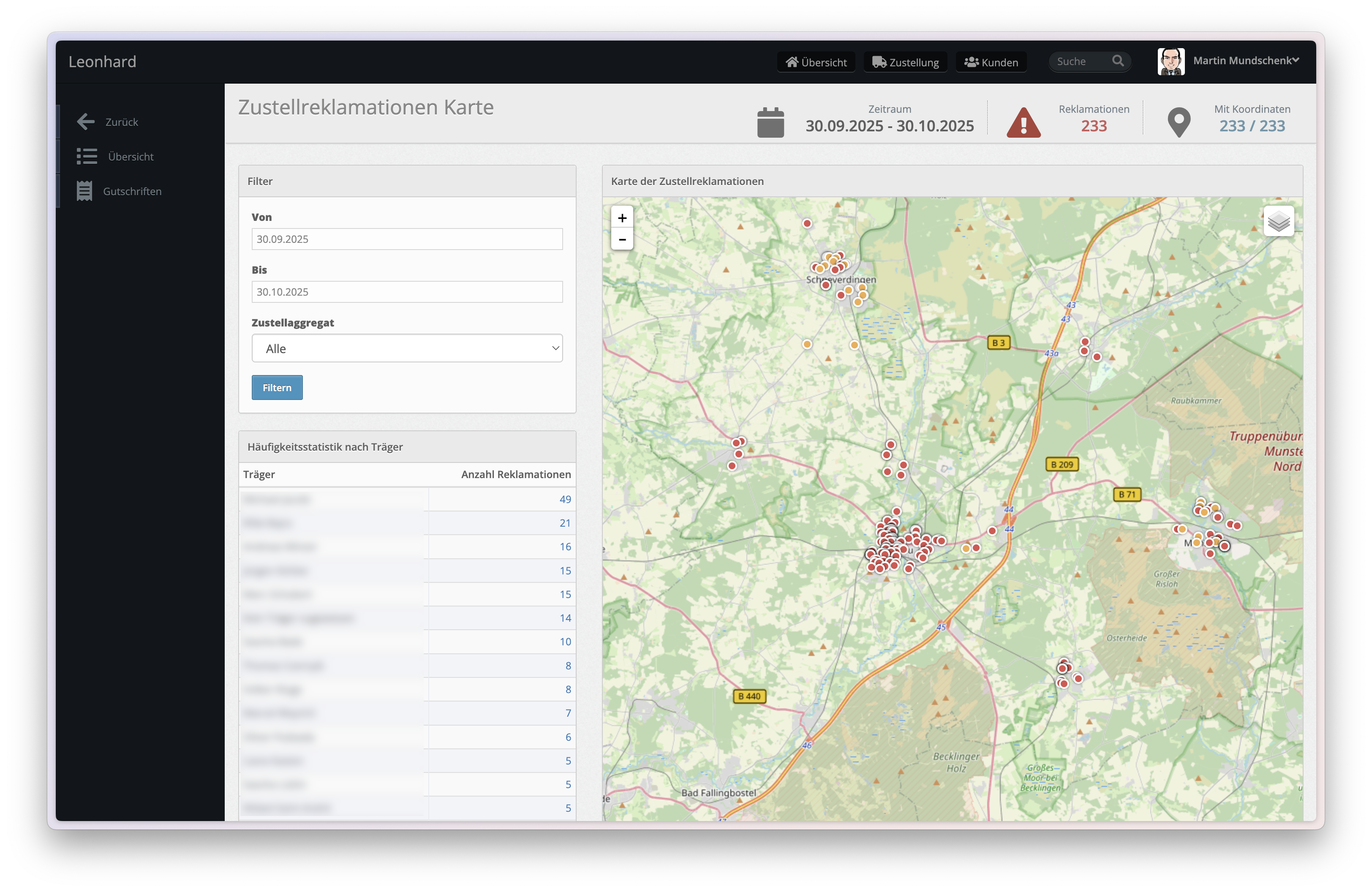
From complaint to process improvement: LEONHARD systematically records every delivery complaint, automatically analyzes problem zones, and gives you the data basis for continuous quality improvement. Objective, transparent, traceable.
Systematic complaint recording: no complaint goes unnoticed
Complaints are unavoidable in the newspaper business: missed deliveries, late deliveries, damaged newspapers or wrong addresses. LEONHARD turns these complaints from an annoying problem into valuable data for quality improvement.
Every complaint is systematically recorded and linked to all relevant contextual data: which customer complained? On which delivery day? Which carrier was responsible? Which round was affected? At which address did the problem occur? This gapless linkage is the basis for all further analysis.
On the final mile, the Paperboy app for carriers provides GPS evidence and round status; complaints can be matched to the specific delivery run instead of being clarified afterward from a list.
The recording interface is optimized for speed: customer service staff enter the customer number or address, select the complaint reason from a predefined list (not delivered, late, damaged, wrong address, duplicate delivery) and optionally a free-text description. The system automatically determines all further assignments.
Complaint categories are freely configurable and can be adapted to your publisher’s specific requirements: weather damage, dog in the garden, letterbox too small, missing nameplate, carrier rang the bell (for ‘do not throw’). The more precise the categorization, the more meaningful the later analyses.
Automatic assignment: from complaint call to complete delivery history
What other systems have to assign laboriously by hand happens automatically in LEONHARD: as soon as a complaint is recorded, the system searches the delivery history and links the complaint to the specific delivery event of the affected day.
The link is made across several dimensions: customer → customer subscription (which subscription was affected?), delivery day → issue (which edition was not delivered?), address → delivery round location (which delivery point in the round?), round → carrier route section (which route section?), carrier (who was responsible for the delivery?), and standard/actual time (how long should the round have taken/how long did it take?).
This granular assignment makes it possible to answer even complex questions: do complaints occur more often when a carrier is overloaded (standard delivery time significantly exceeded)? Are there correlations between relief rounds and complaints? Do complaints cluster under certain weather conditions or insert volumes?
Hotspot analysis per carrier: objective performance assessment
The question ‘Which carrier has the most complaints?’ is only seemingly simple. A carrier with 150 delivery points naturally has more absolute complaints than one with 50 points. LEONHARD therefore calculates the delivery complaint rate relative to the number of deliveries.
The carrier dashboard shows for every carrier: total number of complaints in the selected period, complaint rate (complaints per 1,000 deliveries), average complaint processing time, distribution by complaint type (pie chart), and trend development (is it increasing or decreasing?).
Ranking and benchmarking: the system automatically creates a ranking of all carriers by complaint rate. This makes it possible to identify top performers (and reward them) as well as target carriers who need improvement for focused training. The comparison is fair: only carriers with similar round characteristics (urban vs. rural, similar number of copies) are compared against each other.
Historical development: trend charts show whether training or other measures are having an effect. Has the complaint rate improved after a conversation with the carrier? Are there seasonal fluctuations (e.g. more complaints in winter)? This data enables evidence-based performance management.
Hotspot analysis per address: identify problem zones
Some addresses are ‘repeat offenders’: complaints keep coming in from the same house number. LEONHARD automatically identifies these problem addresses and helps eliminate the causes.
The address analysis lists all delivery points with above-average numbers of complaints. For each address you see: total number of complaints and the trend, which carriers delivered there (was it always the same one or different carriers?), which complaint types occurred (always ’not delivered’ or mixed?), and specific characteristics of the address (apartment building, hard to access, dog, etc.).
Typical root causes: letterbox defective or too small for insert volumes, nameplate missing or illegible, access to the house difficult (locked gate, dog), customer expects the bell to be rung, carrier throws it in the letterbox (a misunderstanding), or the delivery point lies at the boundary of two route sections and is occasionally forgotten. Often the problems are structural or organizational in nature and can be fixed with a one-time measure.
Solution documentation: LEONHARD allows you to store notes for problem addresses that are shown to the carrier: ‘Caution, dog – throw newspaper into the letterbox at the fence’ or ‘Ring the bell at Schmidt (3rd floor), do not put it in the letterbox’. These notes are shown in the mobile carrier app and significantly reduce repeat complaints.
Real-time notifications: react immediately instead of apologizing afterward
By the time a customer calls to complain, the carrier has long since moved on. For critical complaints, however, immediate action is required: a missed delivery can still be made up the same day if it is recognized in time.
LEONHARD offers real-time notifications through various channels: email to the person responsible for operations planning, SMS to the affected carrier (for critical complaints), push notification in the mobile carrier app, Slack/Teams integration for the service team, and webhook to external ticketing systems.
Escalation rules can be defined: if a customer complains for the third time within 14 days, the publisher’s management is automatically informed. If a carrier receives more than 5 complaints in a day, operations planning is notified to investigate immediately (perhaps the carrier was sick and the relief carrier is having problems).
Automatic redelivery: for complaints of the type ’not delivered’, the system can automatically trigger a redelivery: the customer receives a notification (‘Your newspaper will be redelivered by 12:00’), and an available carrier receives the task via the mobile app. This turns a negative experience into a positive service experience.
Root cause analysis: from symptoms to structural solutions
A high complaint rate is only the symptom – the actual causes often lie deeper. LEONHARD helps identify these structural problems through correlation analyses.
Analysis dimensions: are there correlations between complaints and standard delivery time overruns? (carrier under time pressure → careless delivery). Do complaints cluster during relief rounds? (unfamiliarity with round peculiarities). Are there geographic clusters? (certain streets systematically problematic). Are certain weekdays affected? (e.g. more complaints on Mondays after the weekend). Do inserts play a role? (newspapers too heavy → more often damaged or undeliverable).
Concrete recommendations: based on the analyses, the system suggests measures: for systematic standard-delivery-time overruns → restructure the route section. For frequent relief-round problems → improve round documentation, extend onboarding time. For geographic clusters → reconsider delivery district boundaries, possibly too large/too small a route section. For insert problems → adjust payload management, possibly add reloading points.
Continuous improvement process (CIP): delivery quality management is not a one-time project. LEONHARD documents which measures were taken at which point in time and measures their effect. Did restructuring a route section reduce the complaint rate? Were redelivery costs reduced? These successes are measurable and documentable.
Integration with customer communication: transparent and proactive
Customers who complain above all want one thing: to be taken seriously. LEONHARD supports transparent communication and shows customers that their complaint is being followed up.
Automatic acknowledgment: as soon as a complaint is recorded, an automatic email can be sent to the customer: ‘Thank you for your message. We have registered your complaint (ticket number #4582) and will take care of it right away.’ This builds trust and reduces follow-up calls.
Status updates: while the complaint is being processed (e.g. redelivery commissioned, carrier contacted), the customer can be automatically informed. Once the problem is resolved, they receive a closing message asking for feedback: ‘Was the newspaper redelivered? Are you satisfied with the solution?’
Customer portal integration: in the LEONHARD customer portal, subscribers can view their complaint history: which complaints were submitted when, how they were processed, how long processing took. This transparency builds trust and shows that the publisher takes quality seriously.
Quality assurance as a competitive advantage
In times of declining circulation and increasing competition, delivery quality is a decisive differentiating factor. Subscribers expect punctual, reliable delivery – otherwise they cancel.
LEONHARD turns delivery quality management from reactive firefighting into a proactive management tool. Instead of waiting for and reacting to complaints, you identify problems early and fix them systematically. This leads to measurable improvements: falling complaint rates, higher customer satisfaction, lower cancellation rates, lower redelivery costs and better carrier motivation (through fair, data-based performance assessment).
External communication: publishers who proactively communicate their quality figures gain a market advantage: ‘Over 99.5% on-time delivery – confirmed by independent complaint data.’ Such statements are relevant for advertising customers (ads reliably reach their target audience) and attractive to readers (reliable service).
Continuous improvement: the path to excellent delivery quality is a journey, not a destination. With LEONHARD you have a permanent companion that shows you where you stand, where there is room for improvement, and which measures work. This turns delivery quality management from an annoying obligation into a strategic asset.
Discover more features
LEONHARD gives you a comprehensive solution for your newspaper distribution logistics
Delivery route optimization
Proven algorithms from operations research
Newspaper title and edition hierarchy
Map complex media landscapes
Standard delivery time calculation
Daily adaptive recalculation
Delivery district optimization
Multi-criteria optimization of delivery districts
API and integrations
OpenAPI and bidirectional webhooks
AI integration and MCP server
95% automation through AI-native integration
Sandbox and scenarios
Digital twin for what-if analysis
Newspaper carrier payroll
Legally compliant payroll in just a few clicks
Subscription management
Flexible subscription management and IVW-compliant recording
Interested?
Learn more about how LEONHARD can revolutionize your logistics. Talk to us about your challenges.
Get in touch now