What we see is routine. What we have to solve lies in the depths

The delivery area – where the challenges begin

This is where the complexity begins.

This is where the pressure begins.

This is where you feel immediately why the industry pushes its limits every single day.

The city stands for what makes press distribution logistics so distinctive:

narrow streets, pedestrian zones, new housing developments, remote farmyards, closures, construction sites, one-way streets, changing house numbers, poorly lit paths, winter maintenance, public holidays – and all of this within an extremely tight time window.

On top of that come staff shortages, high turnover, minimum wage increases, part-time staff, short-notice absences and the individual peculiarities of every single delivery district.

Press distribution logistics is the only industry that reliably reaches every house in the middle of the night, in every weather, while performing a kind of micro last-mile logistics every day that barely exists in this form anywhere else.

Many of these challenges are so deeply embedded in everyday work that they are hardly spoken of anymore – they have simply become “normal”.

But this is exactly where the misunderstanding begins:

What is everyday reality for practitioners is, from an optimization perspective, a highly complex network problem with thousands of variables, dependencies, cost points and uncertainties.

In the city, the problem becomes visible – but not transparent.

The surface looks orderly. The round runs. The drivers know their district. Routine carries it.

But beneath this visible layer simmers a complexity that only becomes apparent once you actually go into the depths.

The city is the starting point, the frame, the terrain.

But it only shows the visible problem – not its structure.

Logistics as a craft – the practitioners' rowing boat

Press distribution logistics is historically a craft: people with deep experiential knowledge, clear responsibility and impressive operational routine. But they operate almost exclusively on the surface of an ocean full of invisible connections. The rowing boat stands for this status quo: you see what lies directly in front of you – delivery round plans, drivers, time windows, traffic jams, weather, absences.

What you don’t see is the depth beneath: the actual structure of the problem. The dependencies between households, edges, travel times, capacities, marginal costs, wage inflation, product mix, returns, micro-clusters or network effects.

On the surface, much can be solved intuitively – but only up to the moment when complexity rises so sharply that gut feeling alone no longer carries the weight.

Improved tools – a more stable boat, better paddles

Most software providers in logistics barely go beneath the surface: they offer more modern interfaces, digital delivery round sheets, better tracking or automatic reports – and often claim to have thereby solved the big problems.

But these solutions only scratch the symptoms and change nothing about the underlying complexity. Perhaps the boat is improved a little, the paddles more stable, the rudder digital – but the actual depth of the problem remains untouched.

Such software only dives one meter below the surface and then returns: it improves usability and speeds up processes, but it ends exactly where the real structures begin. You do not reach the root of the challenges this way.

Truly deep-reaching solutions require a leap into the depths – to where patterns, dependencies and optimization potential first become visible. Software that stays only on the surface cannot deliver that.

The bottom of the problem – real solutions with operations research

Only by consistently going into the depths do you recognize the actual challenges of press distribution logistics: a time-critical VRP with hard deadlines, capacity limits, multi-trip structures, dynamic traffic data, uncertainties, delivery behavior and hundreds of nodes per round.

Down there – in the darkness – you see the shape of the problem for the first time, in full.

And this is exactly where operations research begins.

Mathematical modeling, graph theory, heuristic optimization, simulation, marginal cost analysis, clustering-based area cuts, VRP solvers: the research submarine that makes the deep sea beneath operational reality visible.

Only with these tools do solutions emerge that do not merely improve symptoms but change the entire system: genuinely optimized networks, fair cost structures, stable delivery rounds, more resilient organizations and sustainable economic viability.

Once you have reached the bottom, you realize: the surface was only a distorted reflection of a much larger world.

The mathematical foundation of all logistics and transport problems is mathematical optimization, specifically as a subfield of operations research

Dr. Martin Mundschenk

Dr. Martin Mundschenk

Logistics optimization at the interface of science and practice

Excellence in logistics optimization requires the interplay of five competencies:

1 Sound domain knowledge of logistics
2 Mathematical modeling expertise in operations research
3 Software implementation expertise
4 Systems-analytical thinking
5 Deep understanding of economic relationships

I combine these competencies and am therefore able not only to formulate complex logistics questions but to fully penetrate them – from the problem through the mathematical model to the technical solution.

In practice, I analyze real publishing and distribution processes using methods of mathematical optimization, translate them into robust models, and then implement these in functioning software and control systems. My solutions combine algorithmic efficiency with practical feasibility in highly dynamic, cost-critical and geographically far-reaching delivery networks.

This breadth and depth allow me to work at the interface between business logistics, modern optimization and applied software development – to recognize structures that otherwise remain hidden, and to design operational systems so that they remain economically and technically viable in the long term.

Academic background

From 1999 to 2005 I studied business administration at Christian-Albrechts-Universität zu Kiel and completed my studies as a Diplom-Kaufmann. Already during this time I focused on quantitative methods, production economics and logistics decision support.

From 2005 to 2008 I continued with doctoral studies at Christian-Albrechts-Universität zu Kiel, which I completed with the degree of Dr. scient. pol.

My doctoral supervisor, Prof. Dr. Andreas Drexl, one of the most internationally renowned scholars in the field of operations research, decisively shaped my scientific orientation. Under his supervision I developed a deep understanding of mathematical modeling, combinatorial optimization and systems-analytical thinking – competencies that are among my central professional tools today. Drexl’s demanding, methodically rigorous school laid the foundation for approaching logistical and economic problems not only from a business perspective but also algorithmically and structurally.

This academic training forms the foundation of my interdisciplinary work, in which I combine economic, mathematical and technological perspectives into independent, practically effective solutions.

Practical experience

Since 2005 I have worked in the fifth generation at the publishing house of the Böhme-Zeitung in Soltau. With the introduction of the minimum wage (Mindestlohn) in 2014, I devoted myself increasingly to the topic of logistics, a subject particularly close to my heart.

The following sections describe problems and solutions that were developed in this company and successfully implemented in practice.

Operations research in practical use in press distribution logistics

Area-independent standard delivery times through regression analysis for every vehicle type

Area-independent standard delivery times through regression analysis for every vehicle type

Determining area-independent standard delivery times was a critical factor from the very beginning: on one hand for the daily dynamic pay of carriers, and on the other as the basis for optimizing travel distances beyond rigid district boundaries.

Data collection and decomposition

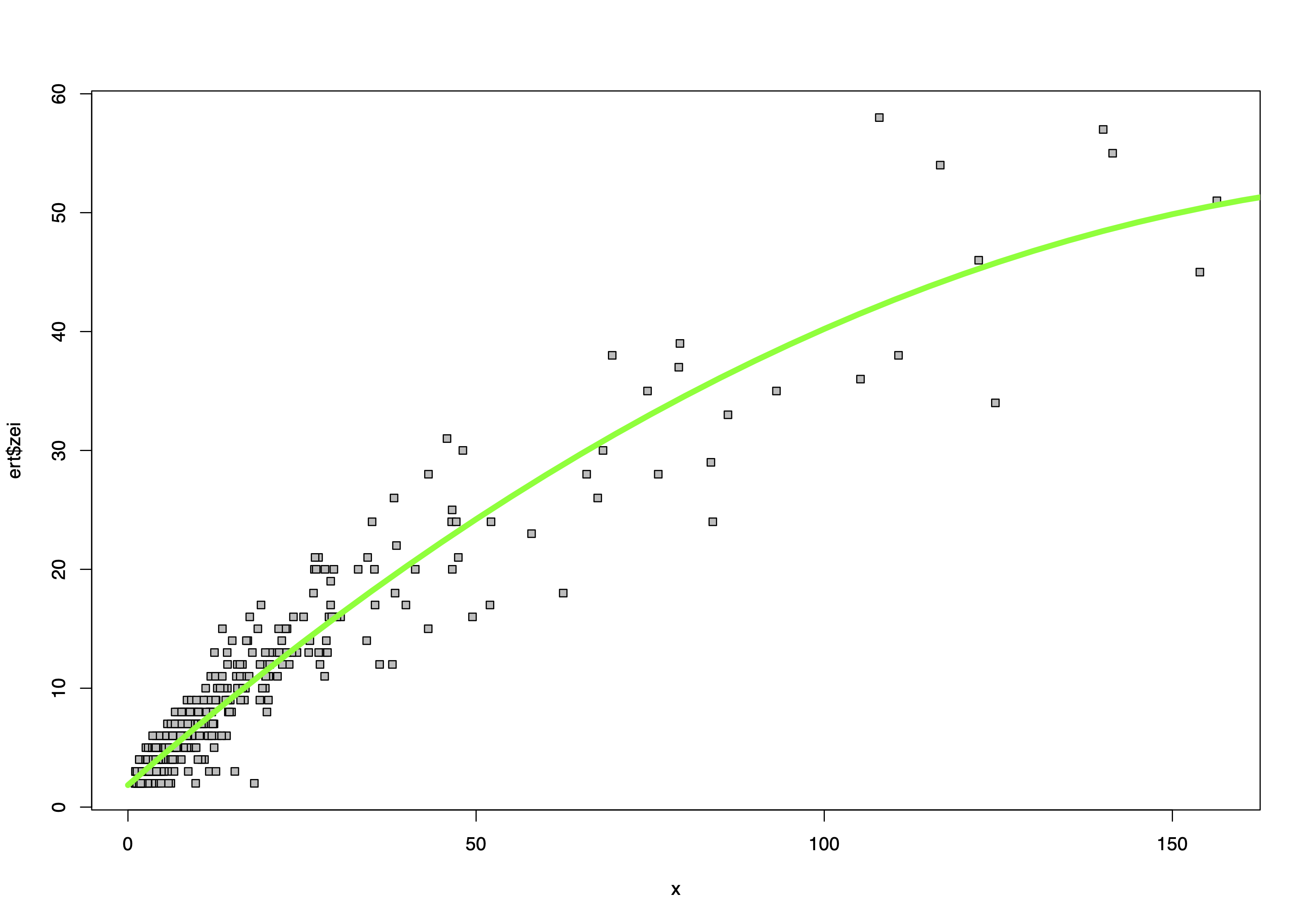
We approached this problem systematically as early as 2014. For all modes of transport in use – on foot, bicycle, e-bike, car, moped and later electric vehicles – we carried out GPS-based distance measurements. This involved a fine-grained decomposition of the collected data down to the level of individual stretches: from letterbox to letterbox. In the end we had more than 6,000 data points available.

Regression analysis as a mathematical-statistical model

With this data we developed a mathematical-statistical regression model that quantifies the relationship between distance and delivery time. Regression analysis makes it possible to estimate a functional relationship from observed data – in our case a production function that converts travel distance into standard delivery time.

For the various vehicle types we achieved coefficients of determination (R²) of around 77%. This means: 77% of the time variance can be explained by distance – a very good value for real delivery processes with numerous disruptive factors.

Validation through Monte Carlo simulation

To ensure transferability to other, unfamiliar areas, we validated the model through Monte Carlo simulations. This stochastic method generates thousands of random scenarios and tests the robustness of the derived functions under varying conditions. The result: the standard delivery times are not only locally valid but universally applicable to any road network.

Up-to-date standard delivery times on the cover sheet

This methodology enables us to print the current standard delivery times on the cover sheets for carriers every single day. The times are calculated precisely per delivery sequence – taking into account all additions and removals for the specific delivery day. This means we do not work with static averages, but with real, daily up-to-date standard delivery times that correspond to the service actually to be rendered.

Dynamic area optimization with the traveling salesman problem

Dynamic area optimization with the traveling salesman problem

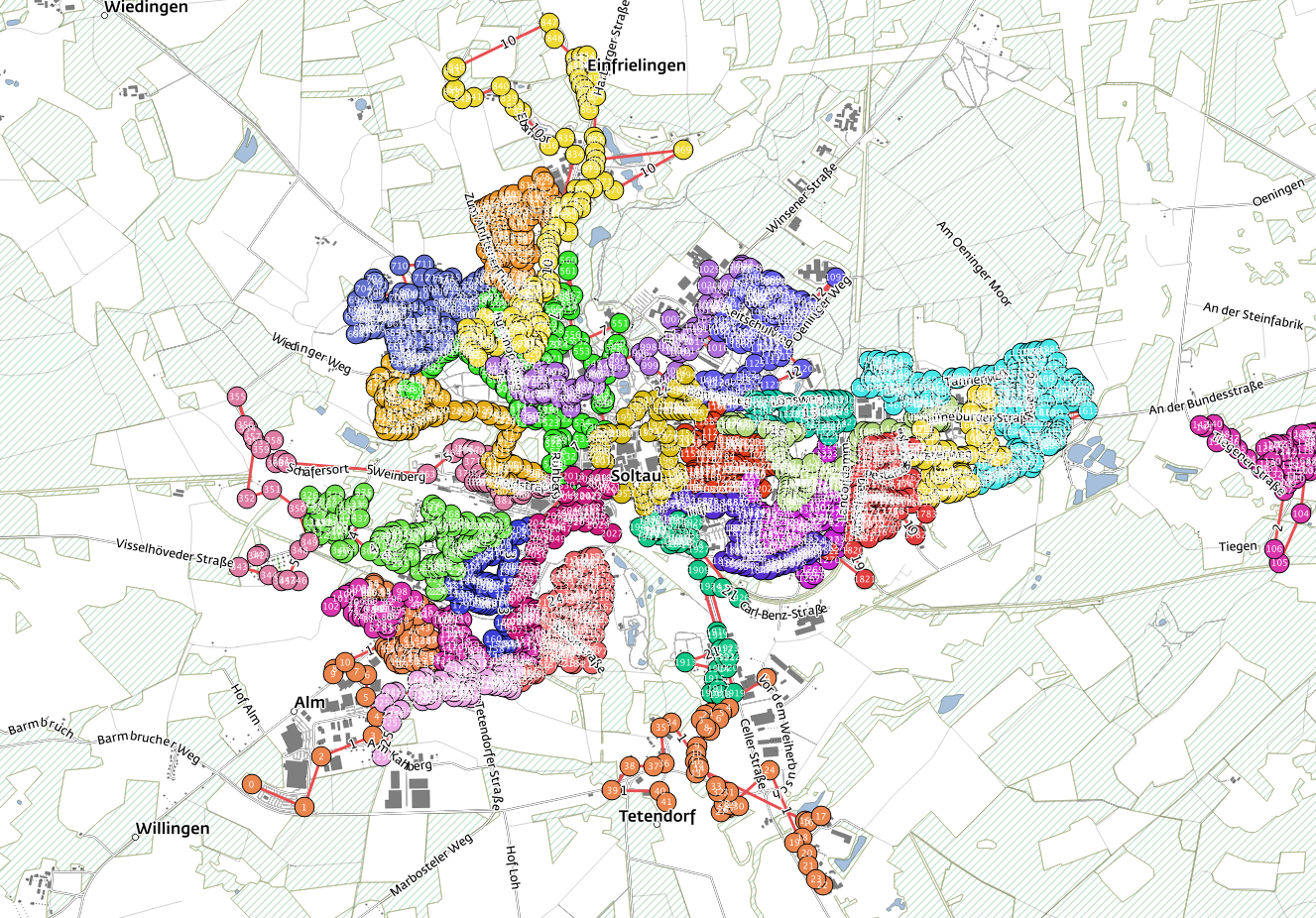
From the very beginning it was clear to us that rigid delivery districts belong to the past. They form units within urban areas that are too small and inflexible and prevent genuine optimization. A systematic improvement can only take place across district boundaries – across the overall area.

The traveling salesman problem as the optimization core

The traveling salesman problem (TSP) is one of the best-known problems in operations research. The question is simple: how do you find the shortest round trip that visits every point exactly once and returns to the starting point? Although the formulation sounds simple, the TSP belongs to the NP-hard problems – for large point sets an exact solution is computationally intensive.

For press distribution logistics, however, the TSP is ideal: every house is a point, and the task is to reach all households via the shortest overall route. Based on OpenStreetMap and house centroid data from the land registry offices, we create a precise distance matrix that also takes into account the access paths from the house centroid to the street.

With modern heuristic methods we solve the TSP for the overall area and obtain an optimal round trip through all delivery points. This round trip is then divided into flexible delivery route sections – depending on the available number of carriers and individual preferences.

Directly usable standard delivery times without further validation

The decisive advantage: because we already have area-independent, scientifically validated standard delivery times, the delivery rounds resulting from the reoptimization can be put into use immediately without further review. The standard delivery times are vehicle-type-specific and distance-based – regardless of the area in which the round lies.

This means: a reoptimization of the complete area is finished within a few minutes, the standard delivery times are automatically calculated correctly, and the number of route sections is not a rigid parameter but a flexible control variable.

Transport logistics with the capacitated vehicle routing problem with time windows

Transport logistics with the capacitated vehicle routing problem with time windows

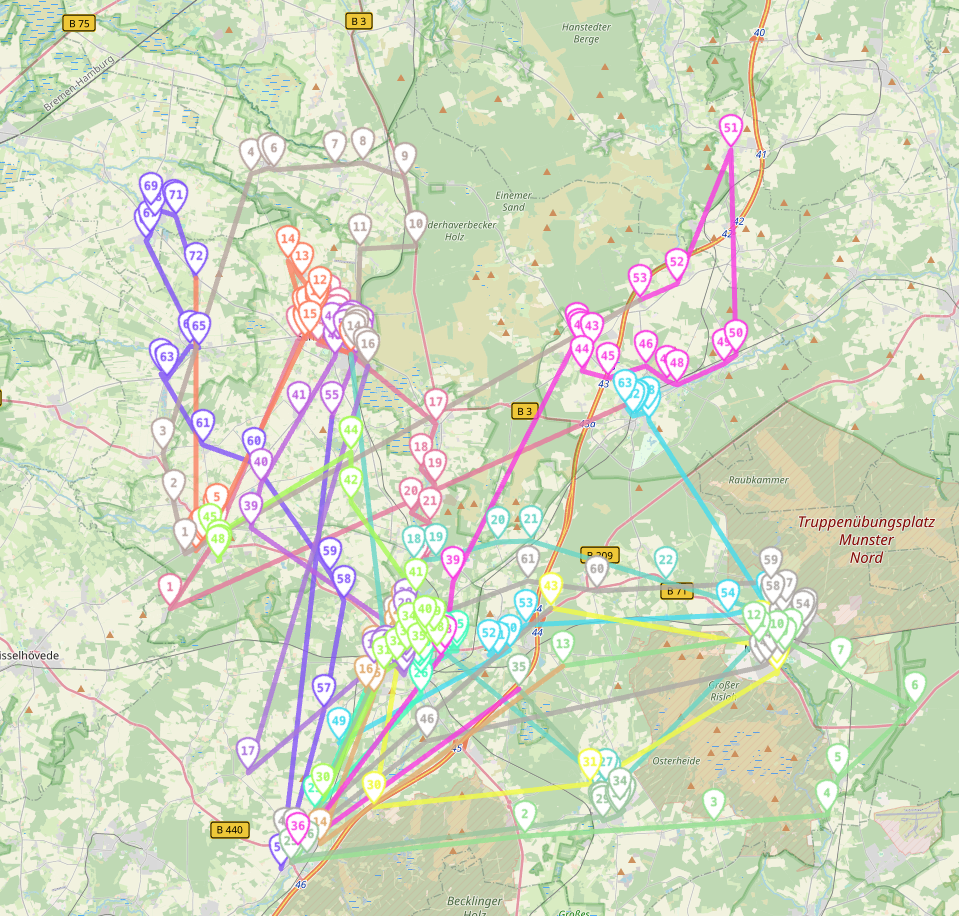
Another central challenge is the transport logistics from the printing plant or depot to the carriers. Traditionally, fixed delivery rounds are used here – an approach that brings considerable inefficiencies and leaves large cost potential unused.

The challenges in everyday operation

In nightly daily-newspaper logistics, dynamic changes arise every day: new and cancelled subscriptions, relief rounds due to sick carriers who have to be supplied considerably earlier than normal. All of this means that delivery rounds are rearranged ad hoc – with corresponding efficiency losses.

For free advertising newspaper delivery, the challenge lies less in time restrictions and more in capacity limits: vehicles are either not fully loaded or hopelessly overloaded. In the worst case a delivery round has to be aborted halfway through to return to the depot, reload, and resume at a far-distant point.

The CVRPTW – one of the most demanding OR problems

The underlying problem is the capacitated vehicle routing problem with time windows (CVRPTW) – one of the most complex optimization problems in operations research. It combines three dimensions: the capacity constraints of the vehicles, the number of vehicles available, and the individual time windows for each delivery point.

An exact solution cannot be computed in acceptable time for practically relevant problem sizes. We therefore use an in-house heuristic based on tabu search – a metaheuristic method that finds very good approximate solutions by intelligently exploring the solution space.

Daily optimization instead of rigid delivery rounds

Our solution optimizes the delivery rounds anew every day. All relevant constraints are taken into account: vehicle capacities, available vehicles, individual delivery time windows. The result is each time the shortest and therefore most cost-efficient round for the given day’s conditions.

Particularly elegant: the latest delivery times for the individual carriers are automatically determined through a backward calculation – starting from the latest delivery time to the reader and the day’s current standard delivery time. This yields the latest delivery point in time for the delivery round in a calculable and traceable way.

Relief for operations planning

The greatest practical benefit: no dispatcher has to keep relief rounds in their head or manually replan rounds any longer. The daily automatic calculation significantly relieves operations planning and eliminates human sources of error while simultaneously optimizing costs.

Route-section rotation – flexible staff scheduling through mixed integer programming

Route-section rotation – flexible staff scheduling through mixed integer programming Route-section rotation – flexible staff scheduling through mixed integer programming - Detail

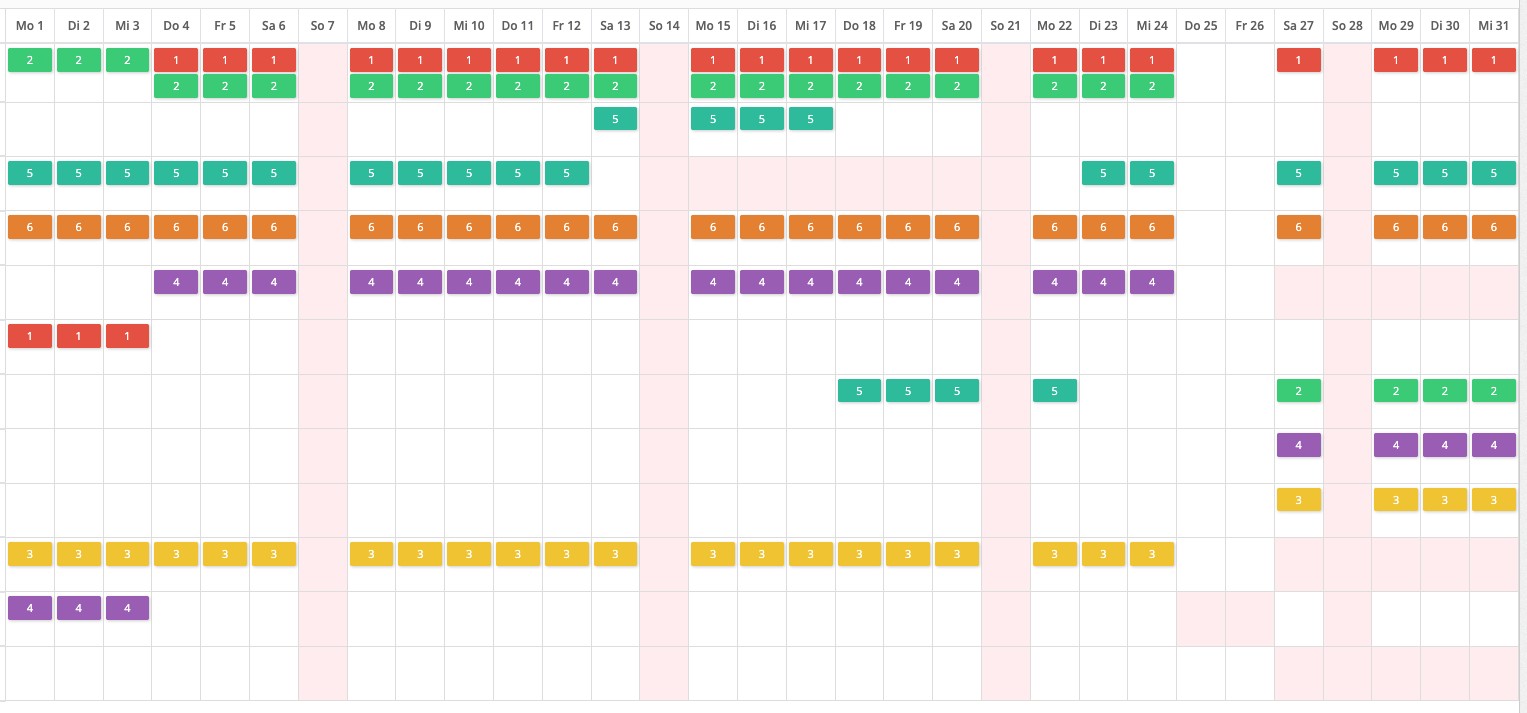
In newspaper delivery, staff shortages frequently occur – due to leave, sickness or short-notice absences. The classic practice of assigning every employee to a fixed delivery district reaches its limits here. We have therefore developed our own optimization model, which we internally call route-section rotation.

The paradigm shift

Instead of assigning each employee a fixed delivery route section, the model plans flexibly depending on availability and local knowledge. The individual working-time limits of every employee are taken into account – both minimum and maximum working hours at daily and monthly level. At the same time the model minimizes the number of changes between different route sections in order to keep onboarding effort low.

The mathematical model

The underlying problem is a mixed integer optimization problem (mixed integer program, MIP). The decision variables are binary: for every employee, every route section and every day it is decided whether an assignment is made or not.

The objective function maximizes the sum of preferences (local knowledge) while simultaneously minimizing the number of changes between route sections. The constraints ensure that all route sections are served every day, employees are only deployed on available days, working-time limits are observed, and only route sections are assigned for which the employee is qualified.

Solution with standard solvers

We solve the model with the open-source solver CBC (Coin-or Branch and Cut) from CoinOR. CBC is one of the most powerful freely available MIP solvers and delivers optimal or very good solutions for our problem sizes in acceptable time.

Practical benefit

Route-section rotation enables robust yet efficient staff scheduling. Short-notice absences are automatically compensated, delivery reliability for all customers remains guaranteed, and employees’ working hours remain within the agreed framework – without manual planning by dispatchers.

Benefits in recruiting

An often underestimated aspect: flexible staff scheduling is also extremely beneficial for recruiting. Nowadays many potential employees already drop out during the application process because they are not willing to work six days a week – a model that was common in traditional newspaper delivery. Route-section rotation takes individual availability into account and also enables part-time models with fewer working days. This considerably widens the pool of qualified applicants and makes the industry more attractive to people seeking flexibility in how their working hours are structured.

Successfully in practical use for years

A software that can do all of that

A software that can do all of that

The search for a suitable software solution for press distribution logistics was sobering: no solution available on the market offered even approximately the functional depth necessary for genuine optimization. Most systems limit themselves to digital interfaces for manual processes – without addressing the underlying complexity.

Out of this shortage we developed LEONHARD: a logistics system designed from the ground up for the specific requirements of press distribution logistics – from practice, for practice.

A decade of development in the stress test of everyday operation

LEONHARD is not software from a laboratory. For over a decade, every development iteration has been measured and proven directly against the daily challenges of press distribution logistics. Every function, every algorithm, every optimization had to prove itself in real operation – under time pressure, during staff absences, in the night shift, under changing weather conditions and unforeseen events. What did not work was improved. What worked was refined further. The result is software that not only convinces in theory but proves every day that it delivers what it promises.

Operations research as DNA

All the methods and optimization procedures described in this document are firmly anchored in LEONHARD: the regression-based standard delivery time calculation for all vehicle types, the TSP optimization for flexible area cuts, the CVRPTW for daily delivery route optimization, and the MIP-based route-section rotation for staff scheduling. These algorithms do not work in isolation but interlock – from the digital twin for what-if analysis to fully automatic support for operations planning.

Complete industry solution

In addition to the optimization functions, LEONHARD offers all standard functions that a modern logistics system needs for press distribution: multi-level management of local and sub-editions with any depth of hierarchy, complete carrier payroll calculation including automatic calculation of pay during annual leave and continued pay during sickness under strict compliance with the requirements of the German Continued Remuneration Act (Entgeltfortzahlungsgesetz).

As a fully API-based platform, LEONHARD integrates seamlessly into existing publishing systems and finally makes newspaper distribution logistics future-proof.

Learn more at leonhard.io