Dynamic Delivery District Optimization
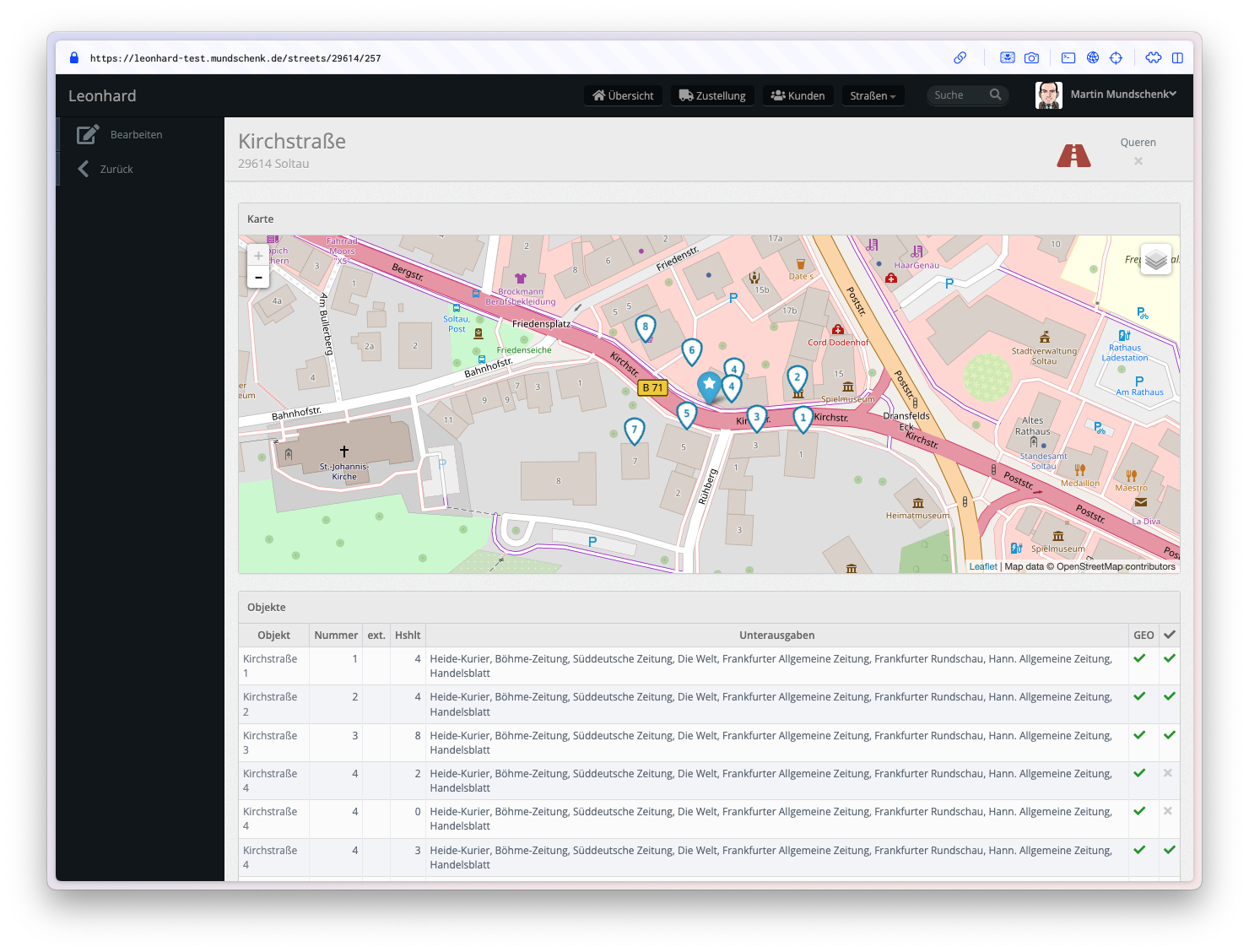
Adapt your delivery district structures to declining circulation – intelligently, automatically and cost-optimally. LEONHARD calculates the most efficient redistribution of your delivery areas at the push of a button.
The problem: rigid delivery districts amid declining circulation
Newspaper publishers face a common challenge: circulation continues to decline, but delivery districts remain unchanged. What made sense ten years ago now leads to uneconomical structures.
The consequence: carriers have fewer and fewer households to deliver to, delivery rounds get shorter, and standard delivery times fall below economically viable minimums. Yet travel costs still have to be paid. The profitability of delivery comes under pressure.
Manual adjustments are time-consuming and conflict-laden: which delivery districts should be merged? Which carriers take over which areas? Who loses income? The discussions are lengthy, and the results are often suboptimal.
The LEONHARD solution: mathematical optimization instead of gut feeling
LEONHARD automates delivery district optimization using operations research methods. Instead of manually merging delivery districts, you define optimization criteria – the system calculates the best solution.
The optimization is carried out using linear integer optimization (MIP) and proven solvers for complex planning problems. LEONHARD formulates the optimization problem mathematically and finds the solution that best satisfies all of your requirements.
Multi-criteria optimization: your priorities at the center
Every publisher has different priorities. For some, minimizing total costs is most important. Others want short travel distances for carriers. Others still value even workload distribution.
LEONHARD supports various optimization goals: minimizing total delivery costs, even workload distribution (all delivery districts similarly sized), short travel distances (carriers live close to their delivery district), minimum standard delivery time per delivery district (e.g. at least 2 hours), maximum standard delivery time (e.g. no more than 5 hours), and contiguous areas (no geographic ‘islands’).
You can combine and weight several criteria: ‘Minimize costs, but keep delivery districts between 2-4 hours of standard delivery time and favor compact shapes.’
Sandbox mode: simulate before implementing
Before you carry out structural changes in production, test them in the sandbox. This digital twin of your logistics enables risk-free experimentation.
In the sandbox you can play through as many optimization scenarios as you like: what happens if we merge 20% of the delivery districts? How do costs change with different minimum sizes? Which carriers would be affected by changes?
The sandbox shows you before-and-after comparisons with cost savings, affected carriers, new delivery district boundaries (visualized on a map), standard delivery time changes per delivery district, and income impacts for every carrier.
Communication and change management
The best optimization fails if the affected carriers are not properly prepared. Structural changes mean change – and change requires communication.
LEONHARD supports you with transparent communication: automatically generated overviews show every carrier personally how their round will change. Visualizations clarify the new delivery district boundaries. Comparison calculations make income changes comprehensible.
Use the sandbox results as a basis for discussion: ‘This is what the mathematically optimal solution looks like. Here are the cost savings. What do we need to consider to make the implementation fair for everyone?’
Phased implementation instead of a big bang
You don’t have to implement all changes at once. LEONHARD enables gradual migration: start with a partial area or individual delivery districts where acceptance is high. Gather experience and feedback.
After a successful pilot phase, extend the optimization to further regions. The software supports mixed operation: in some areas you work with optimized structures, in others still with historically grown delivery districts.
Continuous reoptimization
Delivery district optimization is not a one-time project but an ongoing process. Circulation keeps changing, new housing developments emerge, carriers change. What is optimal today may need adjustment in two years.
With LEONHARD you run reoptimizations at the push of a button, any time – without external consultants, without months-long workshops. The current data is always in the system. The calculations take minutes, not weeks.
Discover more features
LEONHARD gives you a comprehensive solution for your newspaper distribution logistics
Delivery route optimization
Proven algorithms from operations research
Newspaper title and edition hierarchy
Map complex media landscapes
Standard delivery time calculation
Daily adaptive recalculation
API and integrations
OpenAPI and bidirectional webhooks
AI integration and MCP server
95% automation through AI-native integration
Sandbox and scenarios
Digital twin for what-if analysis
Newspaper carrier payroll
Legally compliant payroll in just a few clicks
Subscription management
Flexible subscription management and IVW-compliant recording
Delivery quality management
Complaint management and systematic quality assurance
Interested?
Learn more about how LEONHARD can revolutionize your logistics. Talk to us about your challenges.
Get in touch now