REST API & Webhooks
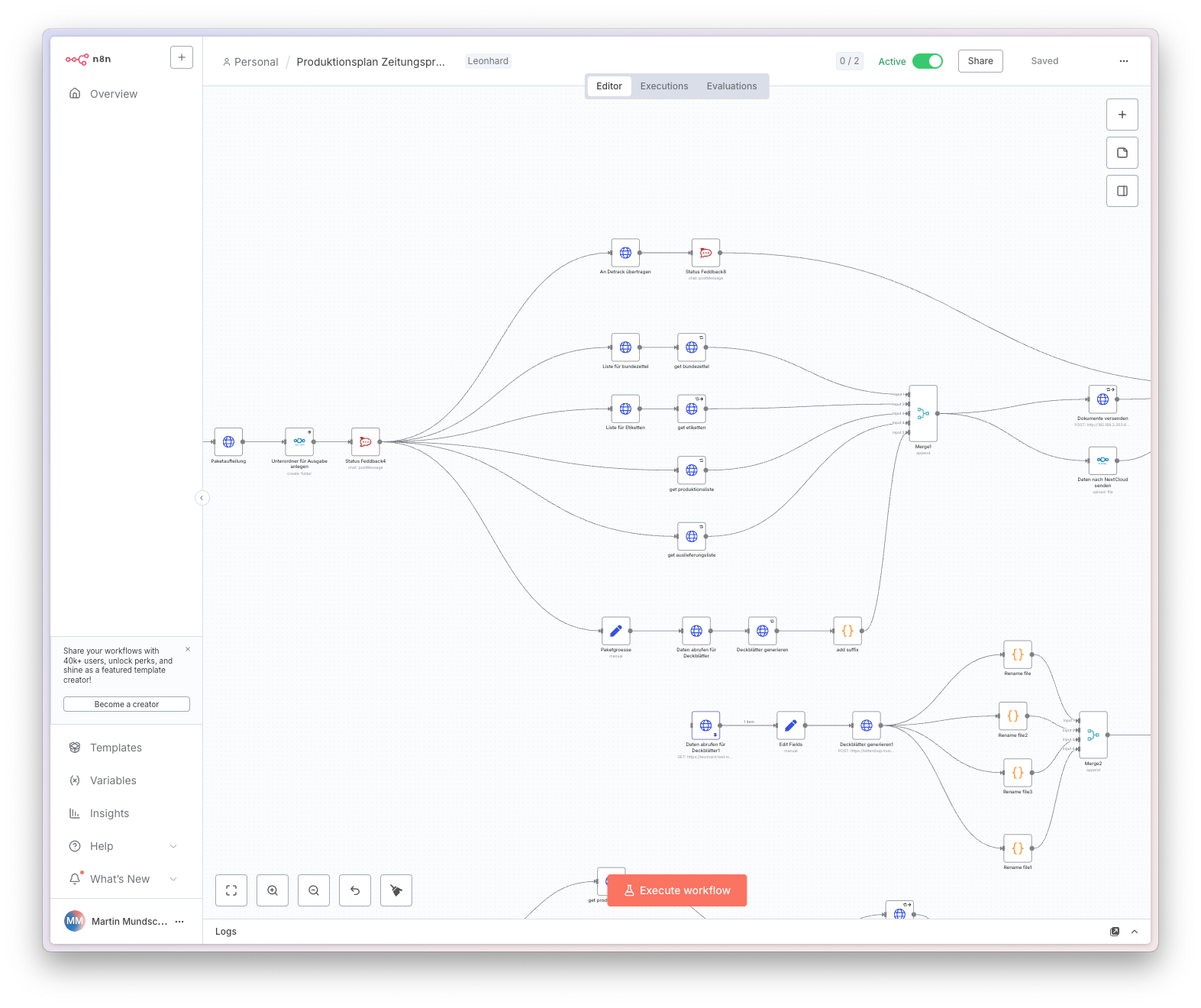
LEONHARD is API-first: every function is available via the REST API. Integrate your existing systems seamlessly – from subscription management to accounting.
API-first: not added later, but from day one
Many software systems had APIs added after the fact – with all the compromises and inconsistencies that brings. LEONHARD is different: the API was the primary interface from day one.
That means: complete functionality via the API (whatever the web interface can do, the API can do too), consistent data models without historical baggage, well-thought-out endpoint structure following REST principles, uniform error handling with meaningful HTTP status codes, and a versioned API for stable integration even as the product evolves.
OpenAPI documentation: interactive and always up to date
The LEONHARD API is fully documented according to the OpenAPI standard (formerly Swagger). This is not just a reference to read – it is an interactive development environment.
Through the Swagger UI you can test API calls directly in the browser, adjust parameters and inspect responses – without writing a single line of code. You can download the OpenAPI specification and import it into your development environment to automatically generate type-safe client libraries.
The documentation is always up to date because it is generated directly from the source code. No outdated manuals, no discrepancies between documentation and reality.
Webhooks: real-time notifications for critical events
While APIs work on a pull basis (you request data), webhooks work on a push principle: LEONHARD automatically notifies your systems when certain events occur.
You can register webhooks for the following events: new subscriptions (for subscription management), delivery round completed (for operations planning), standard delivery time exceeded (for delivery quality management), invoice creation (for accounting), structural changes (for documentation), and many more.
Webhooks enable real-time integration without constant polling. Your system reacts immediately when something relevant happens in LEONHARD – efficiently and with minimal resource use.
SaaS integrations: plug and play with modern tools
Through platforms such as Zapier or n8n you can connect LEONHARD to hundreds of other SaaS tools without any programming. Examples: Slack notification when a delivery round is completed, Google Sheets export for ad-hoc analysis, email notifications via SendGrid, CRM updates in HubSpot or Salesforce.
Native integrations exist for common tools: Chargebee (subscription billing), Stripe (payment processing), OpenRouteService (delivery route optimization), OpenStreetMap (geospatial data), and others on request.
New: MCP server for AI-native integration
LEONHARD goes beyond classic REST APIs: as the first newspaper distribution logistics system worldwide, we offer an MCP (Model Context Protocol) server for direct AI integration.
What is MCP? An open standard developed by Anthropic (Claude) that allows AI assistants to communicate directly with systems. Instead of developers programming APIs, you can simply talk to your system – in natural language.
19 intelligent tools for customer search, subscription management, delivery complaints, address handling and more. The AI automatically selects the appropriate tools and combines them into complex workflows.
Proven results: 95% automation for delivery complaints, response times reduced from hours to minutes, higher data quality through automatic validation.
Typical integration scenarios
Subscription management: transfer daily updated subscriber lists from your subscription system. LEONHARD automatically calculates new delivery rounds and standard delivery times. Cancellations and new subscriptions are taken into account immediately.
Accounting: delivery costs are calculated in LEONHARD and transmitted to your accounting system via the API. Automatic invoice generation for carriers. Integration with DATEV, SAP or individual systems.
Business intelligence: export key figures on circulation, delivery costs, standard delivery times and delivery district structures for external reporting tools. Build dashboards in Power BI, Tableau or Metabase.
Operations planning: automated relief carrier scheduling in case of sickness or leave. Transmission of daily delivery round data to mobile delivery apps. Integration with GPS tracking systems for quality assurance – for example the Paperboy app for carriers on the final-mile newspaper delivery and Roadboy for delivery from the printing plant in the first stage.
AI automation: with the MCP server you can fully automate repetitive tasks. AI assistants handle delivery complaints, subscription suspensions, address changes – up to 95% time savings with higher quality.
Discover more features
LEONHARD gives you a comprehensive solution for your newspaper distribution logistics
Delivery route optimization
Proven algorithms from operations research
Newspaper title and edition hierarchy
Map complex media landscapes
Standard delivery time calculation
Daily adaptive recalculation
Delivery district optimization
Multi-criteria optimization of delivery districts
AI integration and MCP server
95% automation through AI-native integration
Sandbox and scenarios
Digital twin for what-if analysis
Newspaper carrier payroll
Legally compliant payroll in just a few clicks
Subscription management
Flexible subscription management and IVW-compliant recording
Delivery quality management
Complaint management and systematic quality assurance
Interested?
Learn more about how LEONHARD can revolutionize your logistics. Talk to us about your challenges.
Get in touch now