Delivery Route Optimization for Newspaper Publishers
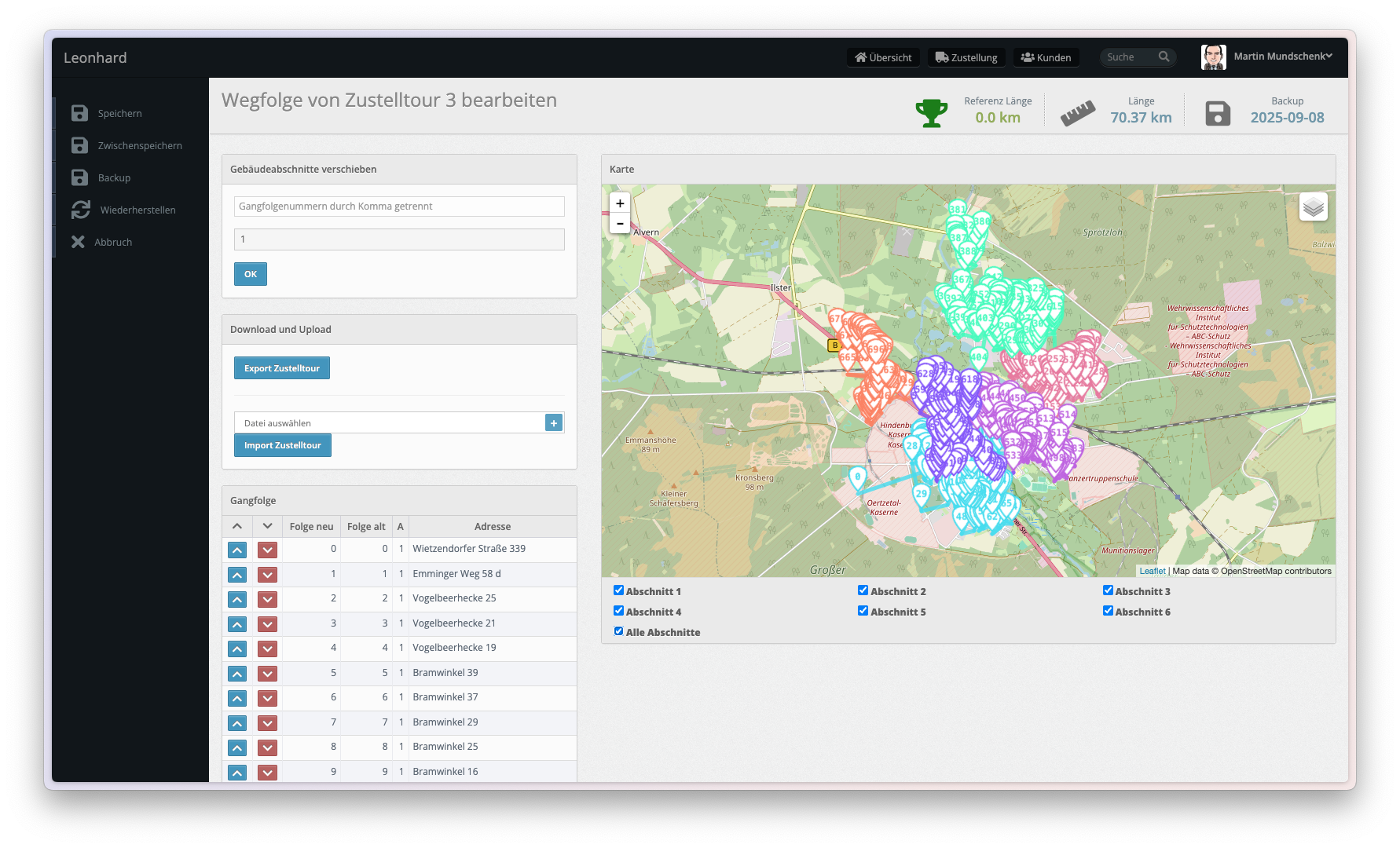
LEONHARD optimizes your entire delivery chain – from the printing plant to the letterbox. With scientifically grounded algorithms, we calculate the most cost-optimal routes every day.
Two-stage optimization process: from the printing plant to the reader
Delivery route planning in newspaper distribution logistics is a two-stage process that covers both levels of the delivery chain: the first stage is the truck distribution logistics from the printing plant to the newspaper carriers. The second stage covers the final-mile newspaper delivery from the carriers to the letterboxes of readers and subscribers.
Both processes require different optimization approaches, which LEONHARD intelligently combines. While vehicle capacities and time windows take center stage in truck distribution logistics, carrier delivery is about minimizing travel distances and fair delivery district allocation.
Truck distribution logistics: dynamic delivery route planning instead of static routes
Traditionally, truck drivers drive the same routes every day – an approach that does not do justice to the dynamic requirements of newspaper distribution logistics. Both the quantities and the total weights change daily, depending on the number of pages and the inserts included.
The consequences of static delivery route planning are costly: vehicles are either underutilized or overloaded. In the case of overload, drivers have to return to the often far-distant depot in the middle of the round, reload, and drive the long way back to the next drop-off point again – all avoidable costs.
LEONHARD recalculates the delivery rounds every day and in doing so solves the capacitated vehicle routing problem with time windows (CVRPTW). This algorithm simultaneously takes into account the delivery time windows and vehicle capacity in order to determine the minimum number of delivery rounds necessary.
The optimization follows several criteria: minimizing working time, avoiding vehicle overload, and meeting delivery time windows. The calculated route is then handed over via the API interface to modern delivery systems that work on a smartphone basis with integrated routing and navigation functions.
For the operational execution of the first stage – delivery from the printing plant to carriers and drop-off points – Roadboy for delivery from the printing plant complements operations planning in LEONHARD with routes, ETA and offline capability for drivers.
Carrier delivery: intelligent route optimization instead of manual delivery district cuts
In optimizing carrier delivery, LEONHARD follows a fundamentally different approach from conventional systems: instead of manually cutting delivery districts, you define contiguous delivery regions once – urban contiguous areas in which newspapers are delivered.
Within these regions, LEONHARD calculates the shortest path connecting all households by solving the traveling salesman problem (TSP). This optimal overall path is then divided into route sections according to your individual criteria.
The advantage of this route-section concept is obvious: in case of sickness or leave, relief carriers simply have to continue along the path instead of having to drive across the region to various, isolated delivery districts. Logistical continuity is maintained.
Changes in the subscriber base – cancellations or new subscriptions – result over time in a new optimal route. This can be optimized either iteratively, day by day, or through a complete recalculation of the TSP.
Continuous reoptimization: recognizing potential, bringing people along
Reoptimizing your delivery areas in LEONHARD happens at the push of a button – without external experts, without elaborate workshops. You can first prepare optimizations in a sandbox environment to analyze the savings potential before implementing changes in the production system.
This approach takes into account an important reality: the best mathematical optimization fails if the people who are responsible for delivery every day are not properly prepared and brought along. The sandbox allows you to communicate changes transparently and prepare the team step by step for new structures.
In this way, LEONHARD combines mathematical precision with practical feasibility – for sustainable cost optimization that actually works.
Discover more features
LEONHARD gives you a comprehensive solution for your newspaper distribution logistics
Newspaper title and edition hierarchy
Map complex media landscapes
Standard delivery time calculation
Daily adaptive recalculation
Delivery district optimization
Multi-criteria optimization of delivery districts
API and integrations
OpenAPI and bidirectional webhooks
AI integration and MCP server
95% automation through AI-native integration
Sandbox and scenarios
Digital twin for what-if analysis
Newspaper carrier payroll
Legally compliant payroll in just a few clicks
Subscription management
Flexible subscription management and IVW-compliant recording
Delivery quality management
Complaint management and systematic quality assurance
Interested?
Learn more about how LEONHARD can revolutionize your logistics. Talk to us about your challenges.
Get in touch now